
BMAD: turning delivery speed into a lasting strategic advantage
Delivery speed is no longer enough when strategic consistency weakens. BMAD structures the decision chain between leadership, business, product and tech teams to secure alignment and strengthen the governance of software projects.
- Published on
- Updated on
- Author
- Alexis Soltysiak
- Reading time
- 4 min read

Turning delivery speed into a lasting strategic advantage with BMAD
In many organizations, performance no longer depends only on the ability to deliver fast. Teams are agile, well equipped and skilled. Yet despite this operational efficiency, a more structural problem appears: the loss of consistency between strategic vision and product execution.
Between leadership, business, product and tech, the common thread weakens. Decisions pile up, trade-offs multiply, but strategic traceability disappears.
When speed hides a structural misalignment
Delivering fast is not the same as delivering right. In many teams, developers build features while Product Owners prioritize and sales teams commit to deadlines. Each player acts under their own constraints.
The problem emerges when these decisions are no longer tied to a clear strategic intent. Priority changes become reactive. Technical debt is underestimated. Trade-offs remain implicit.
Critical point
When strategy is not formalized in the decision chain, it gets diluted in day-to-day operations.
In the short term, everything seems to work. In the medium term, friction grows and external credibility weakens.
BMAD: formalizing the decision chain
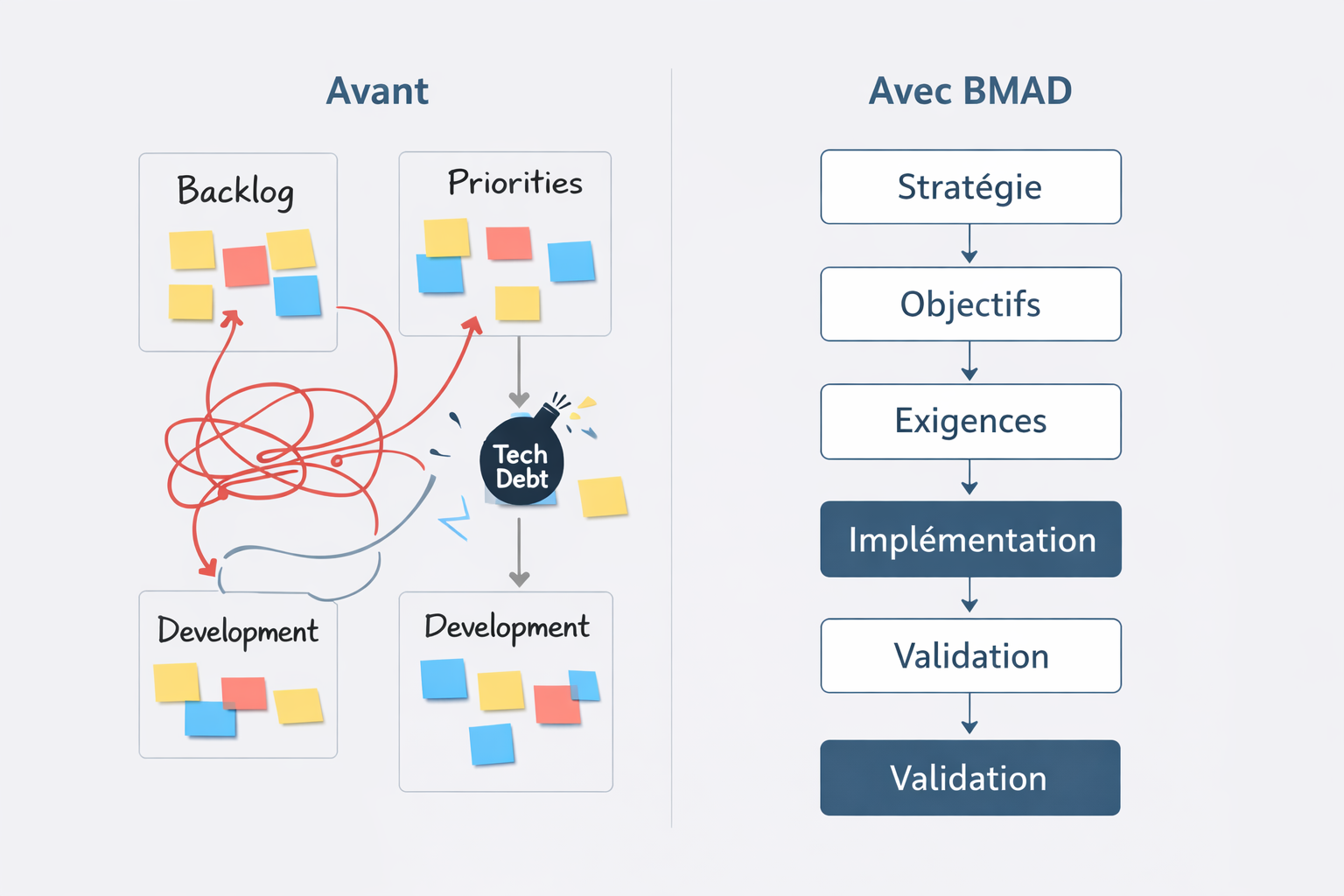
BMAD introduces an explicit distinction between categories of stakeholders: strategic, business, product and technical. Each level has a clear scope and a formal responsibility.
The goal is not to add bureaucracy, but to make sure every decision is tied to the level it comes from. A sales promise, a technical trade-off or a product change must be traceable back to a validated intent.
This structure restores continuity between vision and execution. It turns emotional discussions into factual, documented exchanges.
Key takeaway
BMAD does not slow delivery down. It secures the strategic intent behind every release.
A continuous alignment mechanism
In a typical project, misunderstandings come from a mismatch between levels. The business talks about market opportunity. Product talks about the roadmap. Tech talks about architecture and constraints.
BMAD structures this chain into a logical sequence: validation of business objectives, business scoping, product translation, technical implementation with traceability. Each step is tied to the previous one.
This mechanism reduces gray areas. Trade-offs become explicit. Responsibilities are taken on at the right level.
A concrete case: launching a SaaS module
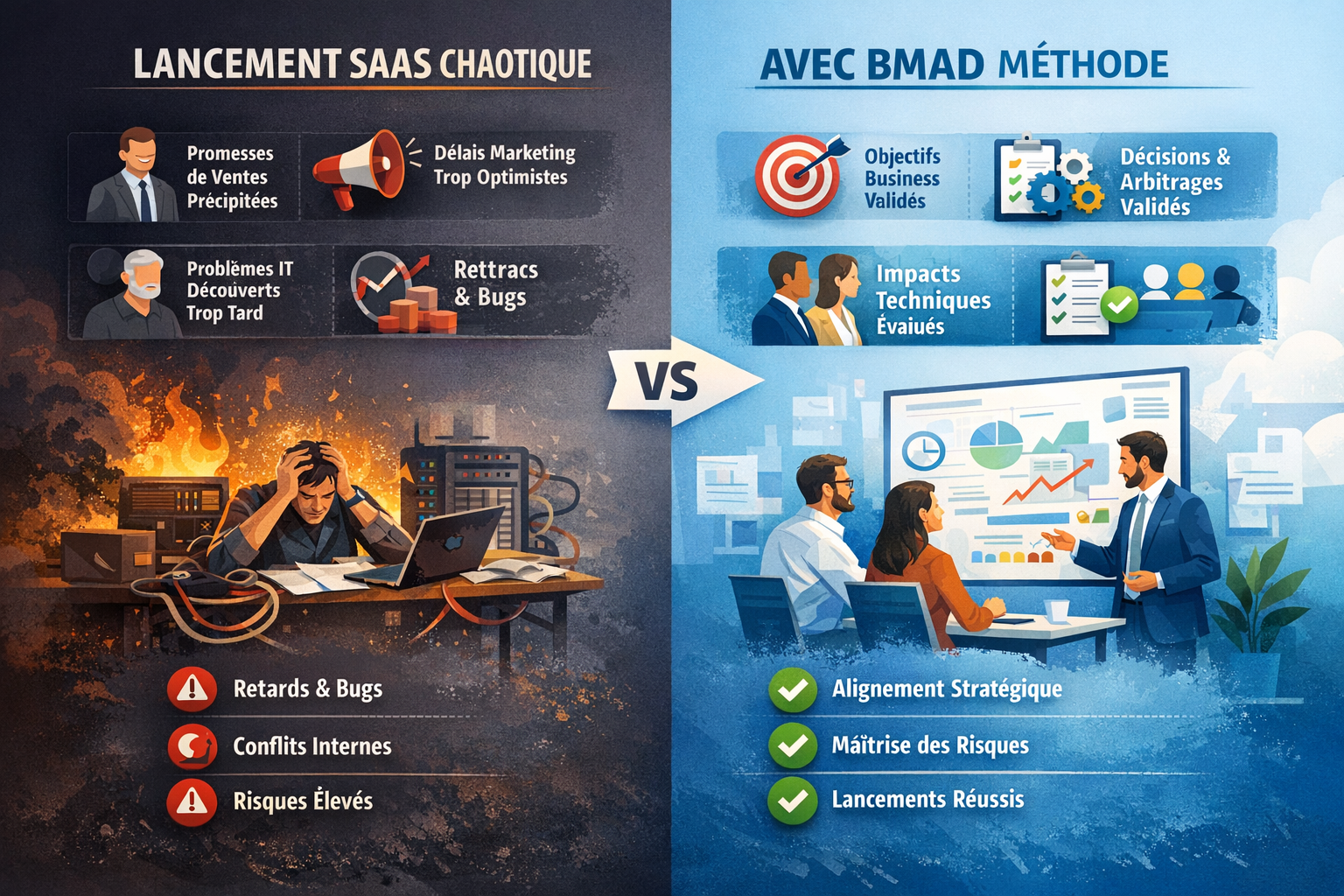
Take the launch of a SaaS module. Without a structured framework, sales commit before technical validation, marketing announces optimistic deadlines, and the IT team discovers architecture constraints late.
With BMAD, the sequence changes. Business objectives are validated upfront. Technical impacts are assessed before any external commitment. Trade-offs are documented and owned by the appropriate decision level.
You do not remove constraints. You remove organizational surprises.
Good practice
Map the major decisions of your last three projects. Identify the level each one came from and any gaps.
From velocity to competitive advantage
Organizations that structure their governance see a measurable impact. Not because developers code faster, but because decisions are more consistent.
-35%
Processing time
78%
Adoption rate
x2.4
Average ROI
These gains come from fewer delays caused by misunderstandings, a more predictable roadmap and less conflict across teams. Speed becomes controlled rather than endured.
A strategic lever for executives
For a CEO, COO or CTO, the challenge is not to steer every technical detail. The challenge is to ensure clarity and clear accountability.
BMAD offers a structured way to read decisions: what belongs to strategy, to the business, to product or to tech. In case of a budget overrun or a delay, the analysis becomes factual. Is it a strategic change? An initial underestimate? A trade-off made at the wrong level?
By clarifying these levels, the method becomes a governance tool. It reduces interpersonal tension and strengthens trust between functions.
Conclusion: structure before you accelerate
Organizational complexity grows faster than teams can absorb it. Delivery speed can mask a latent misalignment. When growth accelerates, these weaknesses become critical.
Structuring the decision chain turns execution speed into a lasting strategic advantage. The question is no longer just delivering fast, but delivering in the right direction.
Take the next step
Assess the maturity of your decision chain and identify the friction points between strategy and execution. Our experts help you set up a BMAD framework adapted to your organization.
Is this topic relevant to you?
Let's discuss your context and how AI can address your challenges.